Need a Custom Size?
We provide custom slit widths and die-cut shapes to your exact specifications.
- Low-cost tooling, 7-10 day lead time
- Large inventory of in-stock tools
- Rectangles, squares, circles, and custom shapes
- Precision slit-to-width available
- Free samples on most products
Related Products
Custom Molded Parts
Let us help with your prototype, short run or large quantity custom silicone and EPDM rubber parts production. Compression molds for parts can be manufactured from your drawings — or tap our expertise to design the part you require.
Custom Molded Mask 1
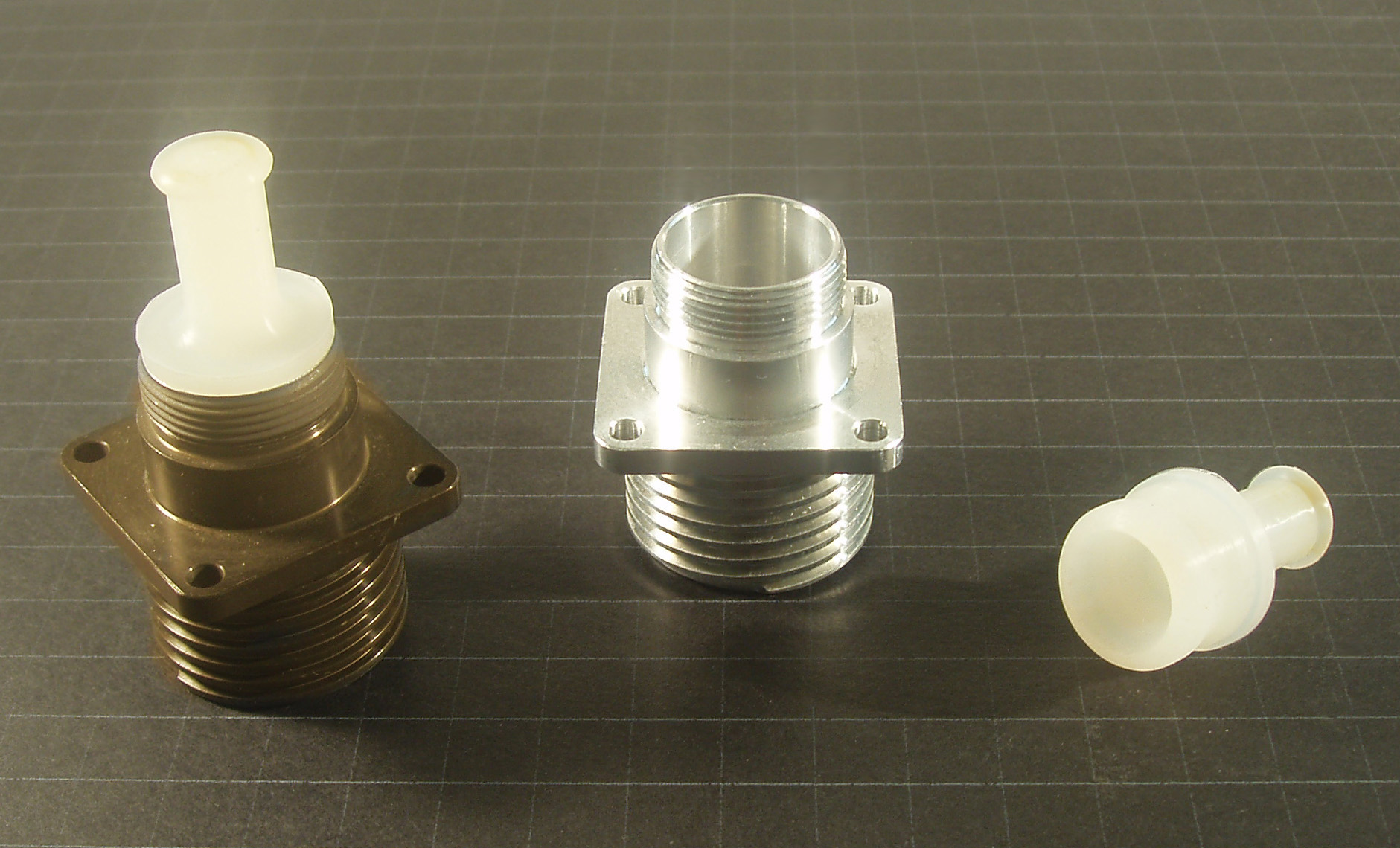
Precision Molded Masks for Aluminum Parts A customer required an aluminum part to be masked on both the inside, and on the very top of the part. Recognizing that this was not well-suited for a tape die cut or a standard off-the-shelf molded part, Viadon designed a custom molded plug to improve masking speed, efficiency and masking of the part. The anodizing process required complete masking of the upper third or so of the internal surface, and the very top of the threaded portion of the metal part. Viadon designed this part with several important components: A flat-sided plug wall, but a radiused section on the front part of the plug to ease insertion. A hollow section in the plug portion of the molded piece; this reduced friction when inserting the plug, and lowered the cost by using less silicone material. A flanged surface at the top to mask the top section of the aluminum part. A large handle to make the part easily identifiable, and faster for operators to insert and remove the plug. We also used silicone that withstands Type 2 sulfuric acid anodizing baths, pairing this reusable silicone solution with a design custom-made for precision metal finishing.
Custom Molded Mask 2
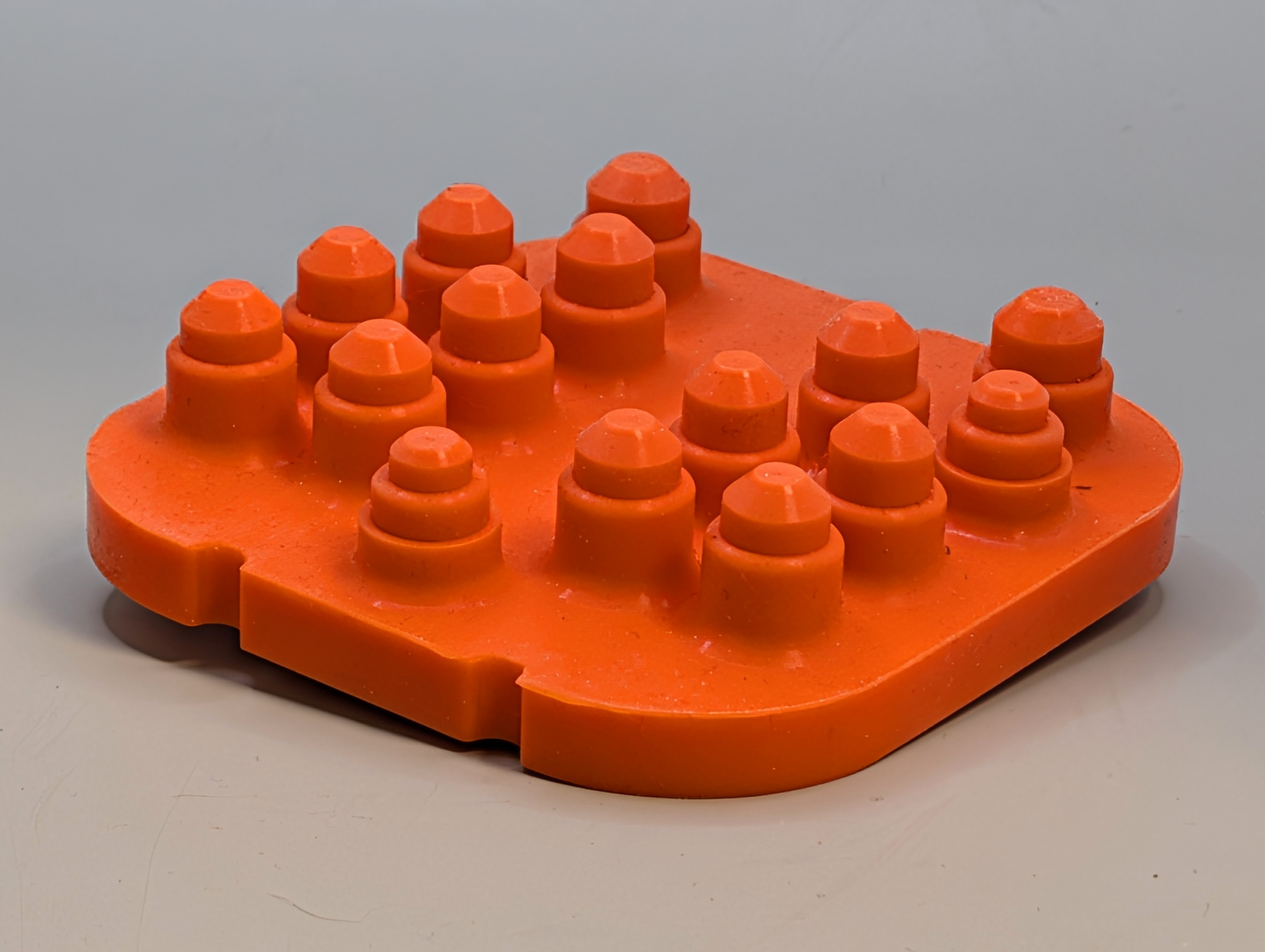
Imagine, if you will, an automotive part requiring 15 total plugs of 5 very-slightly-different sizes that look the same at first glance... all needing to be placed in the same 4" by 4" area. Sounds like a nightmare, right? It was! And then Viadon got involved with a unique solution that streamlined the process and vastly reduced the required labor time. When Viadon first received information about this process, other engineers had proposed multiple, separate plugs to mask the 15 different holes in the brake part a major auto company was developing for a new line of their trucks. We looked at it and asked, "Wouldn't it be easier to put all the plugs on one part, then press them all into place?" The customer agreed this was a worthwhile option to pursue, so we did. After a bit of trial and error (due to the end customer changing requirements) the final masking "pad" of multi-plugs was achieved. And the mask did exactly what it needed to do during the anodizing process, masking all 15 holes repeatedly, allowing for plug application and removal in a fraction of the time multiple, separate plugs would have required. Viadon made the part with three locator pin cut-outs, and provided the mask over time in different colors, so the customer could use the masks for a specified period and then switch to a new color to ensure consistency of results. Have a unique challenge for a masking requirement? Ask Viadon - we look at projects with a bit different perspective that saves time and money for our customers.
Custom Molded Mask 3
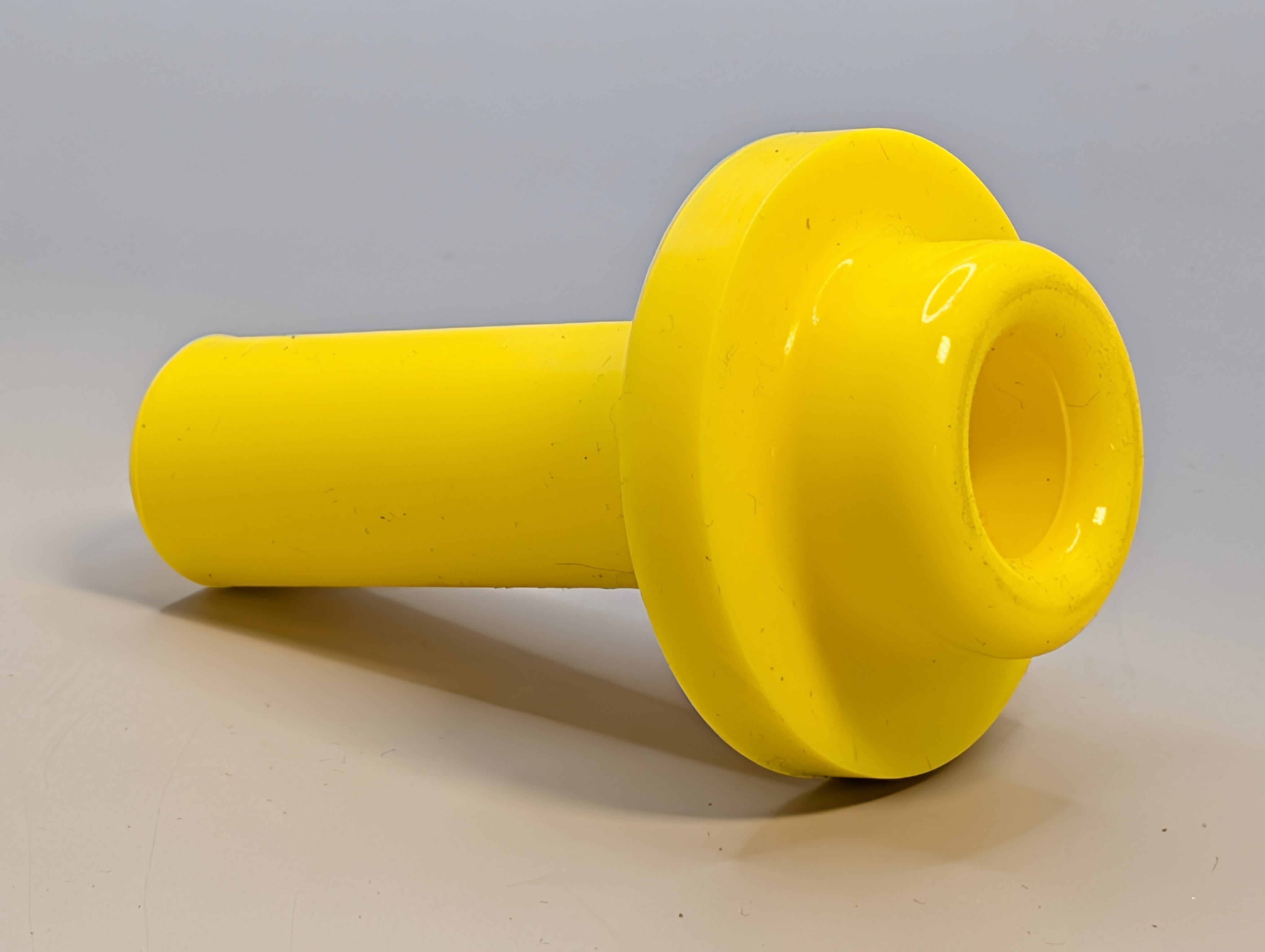
One of the challenges with masking tubes or other parts that trap air inside while the part needs to go through a curing oven is that air heats up. And if you remember from your science classes, heated air expands. And when the weak point in that system of "part, coatings, masking" is a plug or cap holding superheated air in place, sometimes a blowout occurs, which can ruin a part or cause costly rework. Viadon used superheated air along with the the scientific principle of air pressure to relieve that problem by entirely opening up a long fuel tube being ecoated. Because the top of the tube was capped off and the tube was then dipped into ecoat, Viadon made an open 'cap/plug' for the bottom end of this system. Look at the plug on this page. Note the long tubular structure. That's hollow/open all the way through. But the length allows ecoat to partially rise up inside - but - because the air inside is trapped from the cap on top, it stops before reaching the end of the tube, thanks to naturally slightly-higher air pressure inside compared to outside, keeping ecoating from rising to the inside of the tube. This completely eliminated the problem of a cap on the bottom end trapping superheated air during the cure cycle - because air simply heats up and flows out of the tube. This customer has ordered and re-ordered this part many times over, because it continues to just work - and, using simple principles of air pressure to mask a part that otherwise had been problematic for years prior.